Shay
The Vampire Prince’s BrideShay is a dragon shifter, scientist, and partner to Gemma whose arc joins intimate trust to public healing. His decisive contribution is the development of a treatment that reverses the Stlozyn disease, transforming his research from a private effort into a cure with consequences for an entire people. At the same time, his relationship with Gemma advances through gestures of affection, shared domestic life, and the rare disclosure of his true name, Isthæshlyn.
Identity and Private Life
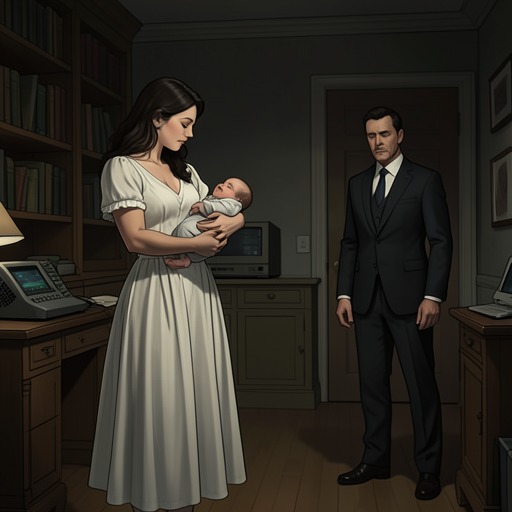
Shay appears in domestic life with Gemma as both a dragon and a researcher. While Ishoel sleeps in the couple’s apartment, Gemma finds him watching a holographic simulation resembling DNA. The scene places his scientific work inside an intimate household rather than separating discovery from care: after Ishoel’s birth, Gemma feels able to give Shay small amounts of her blood for his research, and the contribution is helping him substantially. His work is therefore connected to the family’s trust as well as to laboratory investigation.
His personality also has a playful, physically expressive side. When the holographic projection suddenly switches off, Shay leaps from the sofa, claps his hands, and performs an awkward jig, his robes flapping around him. Gemma has to suppress her laughter at how ridiculous he looks. The moment gives his achievement a human scale: the dragon scientist is not presented only as a solemn expert, but as an exuberant partner whose excitement breaks through his formal appearance.
Scientific Achievement and Public Consequences
Shay’s major objective is to defeat the Stlozyn disease through the combination of human and Stlozyn biological material. He tells Gemma that he has been developing an infusion of human DNA into Stlozyn DNA as a possible vaccine. The result exceeds the original aim. Rather than merely preventing the disease, the treatment reverses its effects, and simulated DNA works just as well, removing the need to harvest human DNA from Earth.
This distinction is crucial. Shay’s cure is not dependent on exploiting scarce human bodies, even though human DNA initially provides the scientific basis for the experiment. The use of simulated DNA converts a potentially coercive interspecies resource problem into a reproducible medical solution. In narrative terms, the discovery answers both a biological crisis and an ethical danger: healing becomes possible without requiring further extraction from humanity.
Gemma immediately recognizes the scale of what Shay has accomplished, telling him that he has cured his people. Shay responds by deciding to accept a position on the Science Board because he has earned it. His professional advancement follows the cure rather than preceding it, making institutional authority the consequence of demonstrated service. He also credits Gemma, telling her that he could never have achieved it without her. The cure thus belongs to a partnership: scientific recognition and personal gratitude arrive together.
Gemma and the Disclosure of Isthæshlyn
Shay’s relationship with Gemma is marked by reciprocal physical affection and emotional confidence. Their private life continues after Ishoel’s birth, and Shay’s research is made possible in part by Gemma’s willingness to provide blood. Their intimacy is not limited to romance; it includes material cooperation, shared risk, and confidence in one another’s purposes.
The most significant personal disclosure comes when Shay explains that he has waited a very long time to find someone with whom he could share his true name. He says that the name is not to be used, even privately, and that real names are spoken only when one individual gives the name to another and then at that individual’s funeral. The custom makes the disclosure a serious act of trust rather than a casual exchange of information.
Shay tells Gemma, "My true name is Isthæshlyn." He explains that it is the name of a hero from an old folk tale whom he admired, and that the name came to him when he was choosing his true name. Gemma treats the revelation as meaningful rather than silly, understands Shay’s nervousness, and repeats the name in her mind. The scene changes their relationship by giving Gemma access to an identity protected by cultural taboo and personal vulnerability.
Conflict, Care, and Narrative Significance
Shay’s arc stands in contrast to the coercive systems surrounding other characters. In the wider narrative, fertility, bodies, and identity are repeatedly controlled by institutions: Cheryl is sent to the Shrine of Nethja with two Kings Presumptive under a rule that will determine the succession through pregnancy, while the Fifth Cycle Festival treats a woman chosen as the Goddess as property of the surviving competitor and has historically ended with her being killed and eaten. Against these structures, Shay’s work offers a different model of interspecies dependence. Gemma’s blood is given within trust, and the final treatment can be made from simulated DNA rather than continued extraction from humans.
The same contrast appears in the naming scene. The true-name tradition limits speech, but Shay chooses to cross that boundary voluntarily for Gemma. His identity is not seized by an authority or exposed through a scan; it is offered as a gift whose meaning depends on consent. That choice parallels the cure itself, which preserves the value of scientific exchange while rejecting the necessity of exploitation.
Shay therefore functions as both a romantic protagonist and a bridge between private devotion and collective survival. His playful celebration, scientific persistence, decision to join the Science Board, and disclosure of Isthæshlyn all lead away from isolation. The character’s defining movement is from guarded knowledge toward shared knowledge: first through Gemma’s blood and collaboration, then through a cure for the Stlozyn people, and finally through the entrusted name that allows Gemma to know him more completely.